![Egg Logo - Coloured Background.png]](https://139813296.hs-sites-eu1.com/hs-fs/hubfs/Egg%20Logo%20-%20Coloured%20Background.png?height=50&name=Egg%20Logo%20-%20Coloured%20Background.png)
Many people believe that having solar installed is a very intrusive process that takes weeks and involves a lot of project management from the customer’s side. You’ll be pleased to hear that we take all the complexities away, take care of everything from the quote stage to the finished installation. Depending on your solar system, the actual install can be completed in just a couple of days!
Depending on the type of equipment you’re having installed, the layout of your property and cable routes, the installation will vary slightly. In this example, we’re going to look at your average two-story family home that is having solar and storage installed.
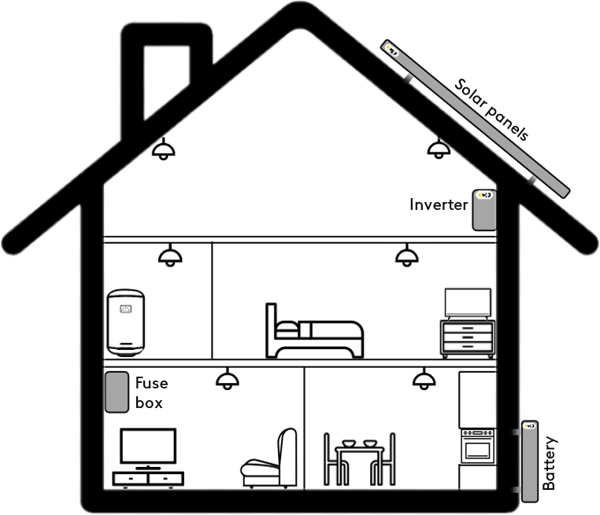
On the image above, you can see a typical household layout and potential locations for the equipment. Depending on your specific property and roof orientation, it may be beneficial to have the battery, inverter and solar to all be installed on the same side of the property. Alternatively, it may be easier to have the battery and inverter near the existing fuse box/consumer unit.
How do we get the panels on your roof?
Prior to the installation, usually a couple of days before, we’ll erect scaffolding around your property to allow the roof aspect to be accessed for the panels to be installed. We’ll try to only do this on the aspect that we need to aspect, however if we need to install edge protection on your roof to ensure our installers can work safely, the work may be slightly more involved. Not to worry though, we take care of all of this for you.
Once the solar system has been installed, we’ll generally leave the scaffolding in-place for around a week. This is to enable us to monitor the solar system and confirm that it’s operating as expected and there are no faults on the system. In the rare instance we identify a fault, it’s much easier to access and resolve whilst the scaffolding is still present. Once we’re happy the system is operating normally, we’ll arrange for the scaffolding to be removed.
How are cables routed through my property?
Generally when installing, we’ll try to locate equipment so that cable routes can be done externally, with minimal intrusion or disruption to your home and existing décor. If we do need to run cables internally, we’ll try and run them out of sight, or within trunking if this isn’t possible. All cable routes will be discussed with you prior to them being installed. This is why we state an appropriate adult must always be at the property during installation, to make decisions on cable routes and other installation decisions if needed.
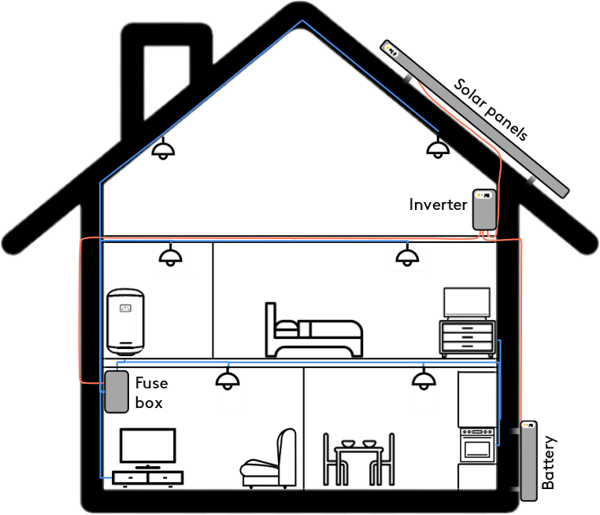
On the image above, there are two coloured lines; blue indicates existing power circuits in the home and red indicates the new cabling that we’ll need to install. In this example, the inverter needs to connect directly to both the battery and your existing consumer unit. Depending on the system you are having installed, this may vary.
Assuming that the loft is boarded and accessible, we may install the inverter in your loft space, close to the solar panels on the roof. We’ll then run cables externally down the wall to the battery and to the existing fuse box. Due to the existing electrical cable installation, supporting joists, other issues under flooring and not to mention the potential of internal décor damage, we may not be able to install cables under flooring or within walls.
How is my roofing and walls made watertight after installation?
The simplest answer to this is that all openings created for the purpose of running cables or installing hardware will be appropriately sealed to prevent moisture ingress. All equipment we install externally to the property is suitable to be installed outside and provides an adequate level of protection against moisture ingress.
For some openings, we may use sealants/adhesives to maintain the integrity of a structure/opening. For others, the fittings, and fixtures we use provide their own watertight seal once installed. When thinking about the mounting structure for the solar panels and framework on your roof, we won’t be completely removing tiles for most systems. Instead, we’ll be modifying tiles to ensure that they fit around the new structure, which we will then refit and they’ll continue to act as a standard roof tile would, maintaining the integrity of your roof.
Who will be carrying out work on my property?
We only use suitably trained, accredited, or experienced installation teams, who specialise in each area of the work. We wouldn’t expect an Electrician to also be an expert on roofs, which is why our teams comprise of multiple people, each with a specialist area.
During your installation, you’ll normally have Scaffolders, Roofers and Electricians at your property, each carrying out works in their respective fields of expertise. Whilst the scaffolding and roofing teams may not be on-site for the duration of the installation, our Electricians will be there making sure everything is connected safely, tested, and certified.