![Egg Logo - Coloured Background.png]](https://139813296.hs-sites-eu1.com/hs-fs/hubfs/Egg%20Logo%20-%20Coloured%20Background.png?height=50&name=Egg%20Logo%20-%20Coloured%20Background.png)
In many cases, the number of panels you need is often calculated by the number of panels you could fit on your roof aspect. If you can fit 14 panels, we typically wouldn’t install 10 or 12. For the small additional costs of completely filling the roof with panels, the extra amount of energy you generate could be significant.
Most panels are around 430 Watts; however the exact power rating will be detailed on your quote. Note that not all panels are equal and there are panels on the market rated at a much lower value. Simply put, the higher the rating of the panel, the more energy it can produce. A 430-Watt panel could produce 0.43 Kilowatt Hours (kWh) of electricity in peak sunlight. If you had 10 of these panels, this would give you a system that could produce 4.3kWh of electricity at its peak.
You may have seen the kWh figure before, as this is also known as a ‘unit’ of electricity. This is what you are billed for and how it’s displayed on your energy bill. Simply put, a kWh summarises how much power has been used over a set period.
Looking at home appliances, a kettle or toaster are high-power appliances, rated around 2.7kW. If you were to a toaster for 1 hour, you would use 2.7kWh of electricity. If we break that down to a more realistic 5-minute period, that works out to be 0.225kWh.

When sizing a solar system and even battery storage, it’s the peak power that needs to be factored in. Although the total energy consumption over an hour for a toaster is 0.225kWh, the instantons power consumption whilst you’re using the toaster is 2.7kW. If your solar system is producing less than this 2.7kW of electricity, you will buy power from the grid. If you’re producing more than this, it will completely power the appliance and still leave you with some excess.
Whilst toasters and kettles are great examples to show what the numbers mean; they are high energy use appliances. When we look at more typical home appliances, such as TVs and games consoles, they use somewhere around 100W (0.1kW) of electricity. This gives you a much more realistic idea of just how much could be powered from your solar system or home battery.
Solar and storage allows you to time shift!
We know that this sounds like something a bit futuristic and complex, but stick with us, it’s not that complicated.
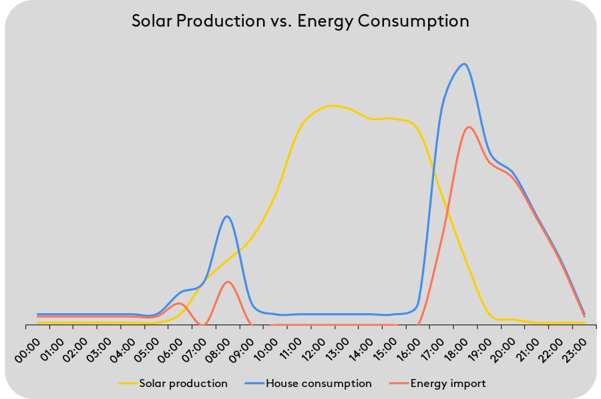
If you only have solar at home and factor in the typical hours that this will produce electricity, this is only within daylight hours. If we take May as an average month, daylight hours are between 05:30 – 20:30, with the solar power only being generated within this period.
If you factor in your typical usage at home, for a family that are out during the day and their primary usage periods are early morning and at night, only a very small amount of the potential solar power would be useful. Although this would offset the bill slightly and money could be made by selling the excess energy back to the grid, this isn’t ideal. Of course, if you are at home during the day, your energy consumption would change and you may be able to use more of it, but likely some of it would still be exported back to the grid.
By adding battery storage, you can time shift your energy consumption. What exactly does this mean? While you’re out of the house or not using the solar energy, instead of being sent back to the grid, this can be used to charge your home battery. When you arrive home, you’ll be able to use any solar power that’s available for anything you need around the house and when solar power drops too low, instead of buying energy from the grid, your home battery will supply the power. Although there may be instances when you’re using a lot of energy and the battery can’t supply enough power, this will be supplemented by the grid instead of importing all the energy, meaning you still reduce your energy costs.
The energy in your battery should be enough to then power your home overnight and into the morning, before the process starts again.
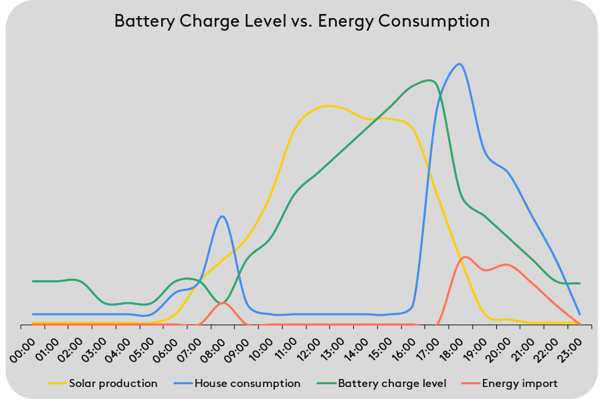
This means that the overall energy import (purchased energy) is much lower and in some cases could be close to zero depending on your system size, energy consumption and battery size. On the two example graphs above, the energy import is shown by the red line. The smaller the area under this curve, the less energy that’s being purchased from the grid.
If you still find that solar and battery storage isn’t enough to meet your household demand, there’s a couple of things that you could do. If your battery storage isn’t big enough for the energy you’re generating, you can ‘stack’ batteries to increase your storage capacity. Alternatively, if you’re not utilising all your battery storage capacity, using a dual-rate tariff will allow you to charge your home battery at night with cheaper electricity and then use this during peak times to power your home, where solar alone may not be enough!