![Egg Logo - Coloured Background.png]](https://139813296.hs-sites-eu1.com/hs-fs/hubfs/Egg%20Logo%20-%20Coloured%20Background.png?height=50&name=Egg%20Logo%20-%20Coloured%20Background.png)
Although the charger’s maximum output is listed as ~7kW, there are a several factors that can impact a vehicles charging speed including:
- Battery temperature
- Battery charge percentage
- Maximum battery charging rate
- Household demand (Active Load Management)
- Loading on the vehicles electronic systems (i.e. if a Telsa is charging but games are being played on the central screen, or the AC is turned on)
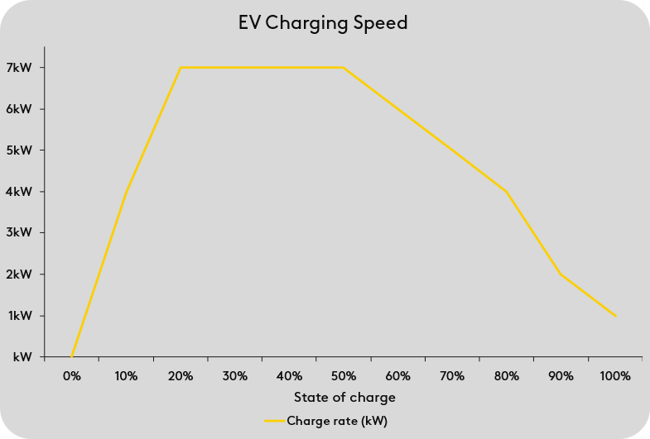
Battery state of charge
Depending on the charge state of the battery, most batteries only charge at full rate up to around 80%, however this can vary depending on the vehicle itself. This will then start to drop off slowly as it approaches 100%. This is because batteries don’t like to be sat at 0% or 100% and are generally happiest when their charge state is somewhere in between. This is also affected by the temperature of the battery; if the battery has been charging at 7kw from 0% to 50%, this will have created heat in the battery, which may then reduce the charge rate to maintain a stable temperature.
Types of vehicles and charge speeds
When considering the vehicle's ability to charge, this could mean that although the charger can supply up to 7kW, the car cannot receive that amount of power and will instead use a lower amount of power that the car dictates. While fully electric vehicles can normally accept up to 7kW, hybrid vehicles may not be able to.
Known examples of this are:
- Mercedes B Class
- MG HS Hybrid
- Certain other hybrid vehicles
In the above examples, you will likely notice that the charge speed is limited to ~3.6kW. This is not a limitation or a fault with the charger and this is due to the vehicle being charged. Although you may be able to receive faster charging speeds if your vehicle has a fast DC charging connection, for home chargers, this will be the same on all home chargers.
How does household demand affect charge speed?
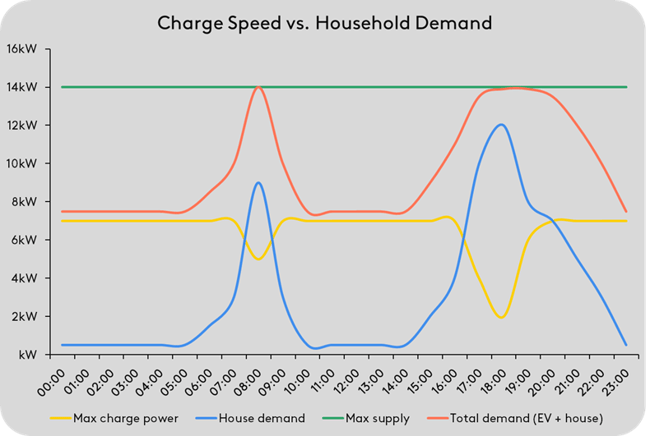
All our chargers include ‘Active Load Management’ (ALM) as standard, which protects the main household fuse when demand is high. ALM will always prioritise household consumption and will slow down charging speeds to ensure the main household fuse is not blown.
A typical household supply can power a home with approximately 14kW of power at any time. If your home is using 8kW of power, this means that there is only a maximum of 6kW available for the EV charger. The graph below shows the total household supply, the household consumption at various points in the day and the resulting charge speeds when demand is high.
In a typical home, energy consumption would generally be low enough to now impact a charger, however when electric showers, ovens, hobs, and multiple other high-power items are used at the same time, this can very quickly add up.